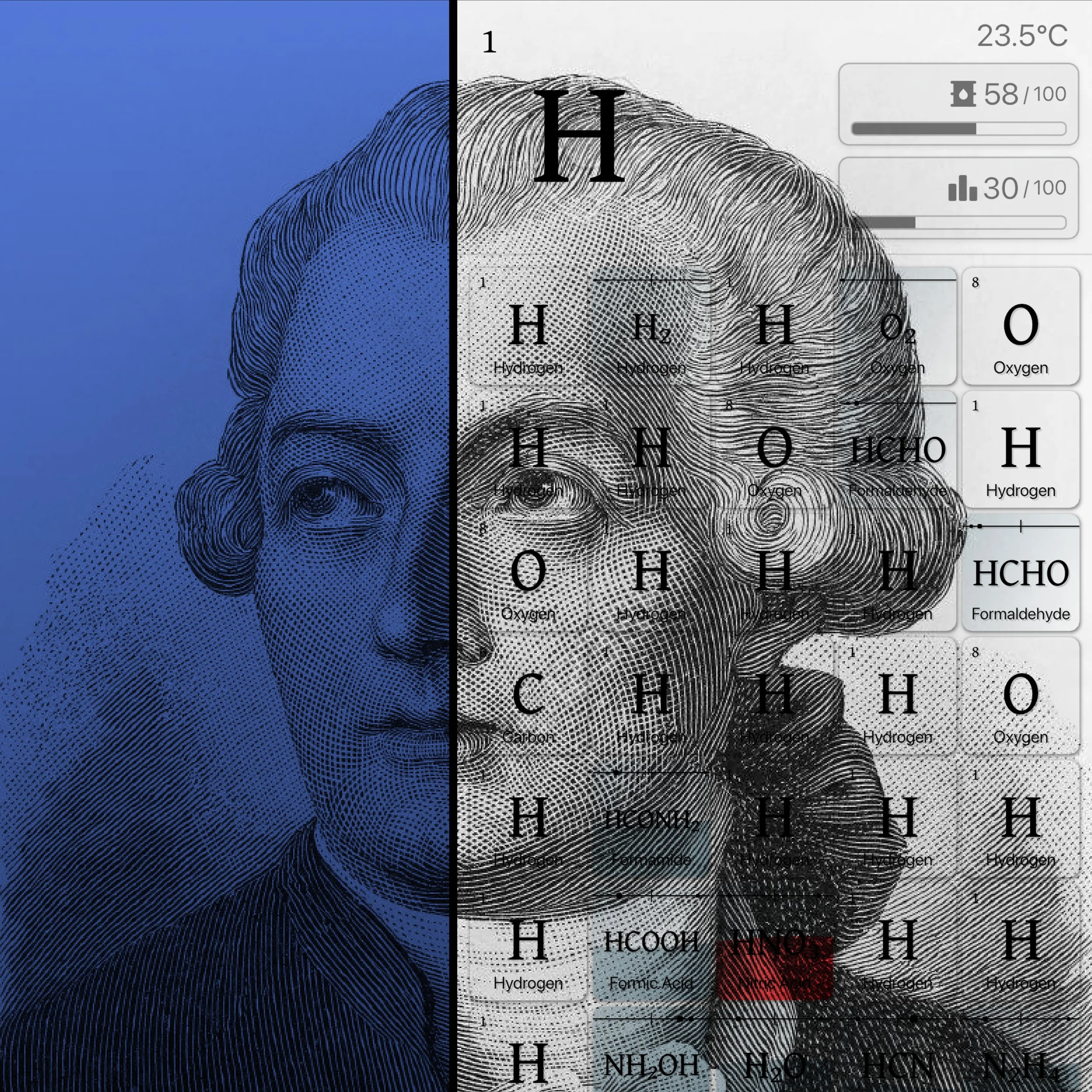
"In nature, nothing is created, nothing is lost, everything is transformed." — Antoine Lavoisier, Traité Élémentaire de Chimie (1789)
"In nature, nothing is created, nothing is lost, everything is transformed." — Antoine Lavoisier, Traité Élémentaire de Chimie (1789)
Play Cycle
In Alcyone, you combine elements arranged on a grid to synthesize molecules. When matching molecules are gathered together, a reaction triggers, adding to your score.
Grid
The grid size automatically adapts to your device:
5×7 Grid: iPhone and most Android smartphones
6×6 Grid: iPad, Android tablets, and foldable devices (such as Galaxy Z Fold)
Elements are placed across the grid, and the core gameplay revolves around combining them to synthesize various molecules.
Synthesis
Selecting Cells: When you tap a cell on the grid, other cells in the same row or column that can be combined with it will be highlighted in red.
Combining: Tapping one of these red cells synthesizes a molecule. This molecule is formed using the elements from all the cells between them, including the initially selected blue cell and the newly tapped red cell.
Result: The newly synthesized molecule appears at the exact location of the red cell you just tapped, and the other cells involved in the synthesis become empty spaces.
Alignment
Once a molecule is synthesized, its state is set to gas, liquid, or solid depending on the temperature. These states follow distinct physical behaviors: liquids and solids sink to the bottom, while gases float to the top.
While cells of the same state do not rearrange among themselves, they follow a strict layering hierarchy:
Solids always sink to the very bottom, below both gases and liquids.
Liquids sink below gases, but will always rest on top of solids.
Element and functional group cells are treated as gases and move in the exact same manner.
Reaction
When the alignment phase is complete, a reaction occurs if identical molecules are located in adjacent cells.
These matching molecule cells react and are converted into score, leaving empty spaces behind.
Once the reaction ends, the alignment phase triggers once more.
Filling
If no identical molecules are adjacent to each other after alignment, the empty spaces are filled with new elements.
The elements that fill these gaps are chosen at random from the remaining elements in the element pool.